Coaching is leadership.  The one thing all coaches should start doing immediately is studying leaders.  In Part 1 I discussed how reading books and articles on leaders in industry and sports is critical to the development of a coach.  In case you missed it, below is a link:

The One Thing You Should Start Doing Immediately

In Part 2 of Leadership Study I will provide three ways in which you can enhance your leadership through observation and listening: utilizing podcasts, audio books, and videos; observing another coaching staff; and leveraging the knowledge of other coaches in your department.

If you don’t enjoy reading, or you struggle to find time; podcasts, audio books, and videos are a great way to gather knowledge.  As baseball coaches we spend a lot of time driving. During the summer we are traveling from one event to the next and the spring months are filled with time on a bus.  When I was younger this was my time to listen to music or talk radio.  As I’ve gotten older I’ve learned to use this time to invest in gaining knowledge. Below are three Podcasts that you should know about:

1.  Top Coach Podcast- They do an amazing job of lining up top coaches from all levels to discuss their programs.

2.  KWB Radio Joe Ferraro and Kevin Wilson’s podcast focuses on hitting but they also have great guests with elite knowledge in all aspects of the game.

3.  Brian Cain- An expert in the “Mental Conditioning”, Cain has recently developed a podcast.

In addition to the podcast, I began investing in audio books.  Two guys who I regularly have in my headphones are Anthony Robbins and Brian Tracy.  Anthony Robbins is the master of providing tips to motivate yourself.  Brian Tracey’s “Goals Program” is definitely worth researching.

Every Tuesday are the press conferences for NFL coaches.  You can watch the majority of press conferences on nfl.com.  You can learn a lot simply listening to how these coaches discuss their teams strengths and weaknesses.

The second way to gather leadership information is by observing another coaching staff. This will be the best investment you ever make.  I have been to several conventions and clinics, but I have learned the most by watching other coaching staffs, hands down!  Heres’ some advice on how to make the most out of your observation:

1.  Pick a program that you or others admire.  Do some research.  Of course everyone wants to watch elite SEC and ACC programs work.  While seeing these programs is fantastic; oftentimes, they have staffing and other resources that makes it difficult to transfer the information to your program.  There are some truly outstanding small school coaches and high school coaches that are providing a great baseball education.

2.  Call or email the coach in advance. I like to speak to the coach prior to see if we can sit down either before or after for a conversation.  This is my favorite part of the visit and allows for great learning.  The majority of coaches will honor this request.

3.  Try to take one thing away that will impact your program.  Just like we tell youth campers, if you can leave with one nugget of knowledge it was worth the trip.  I wouldn’t look to change your whole  program; instead, I would try to find one powerful concept that you think will make a difference in your program.

Another great way to study leaders is to leverage the knowledge of other coaches in your department.  My favorite question to ask coaches, “What’s the one thing you are doing in your program that we should be doing?”  You would be amazed how much this one simple question has impacted me.  This year alone we have changed our player evaluation forms, how we handle our “leadership committee”, and our recruiting materials stemming from this question.  Many of your colleagues are doing really outstanding things; therefore, why not reach out to them and ask for advice?  It takes confidence and humbleness to seek out assistance from your peers.

Continual learning is an important part of leadership.  You and your program can learn a lot about leadership simply by observation and listening.

Two questions for you:

1.  What podcast, audio books or videos do you recommend?

2.  What coaching staff: high school or college would your recommend observing?

On Thursday we will discuss the final piece in studying leaders: surrounding yourself with people who are passionate about success.

Be outstanding,

Mike Deegan

So, you want to be a great coach?  My guess is you love the game and you enjoy making a difference in young people’s lives. What’s the one thing you can do to help excel in the profession that most people fail to appreciate? Start studying leaders!   Please do not be mistaken, coaching is leadership!.  I am thoroughly convinced that an elite basketball or football coach could quickly develop an elite baseball program with little or no knowledge about the intricacies of the sport.  Running a program (or business) consists of developing a compelling vision, relentlessly communicating that vision, inspiring others (and yourself), and taking massive action to be successful.  The best news is you do not have to be a trailblazer; there is no shortage of incredible leaders to analyze.  During the past 15 years I have been obsessed with learning what the best do better than everyone else.  This is the first of a three-part series on how to increase your leadership knowledge.  The first post will focus on what to read, the second part will discuss learning from observing and listening, the third post will focus on surrounding yourself with people who are passionate about success.  The first key to your leadership development is getting your nose in a book.

1. READ, READ, READ, READ

That’s right, turn the TV off, open up a book and get to work.  When I was 25 I heard that a good goal was to read a book a week for a year.  If you were to read a book a week for 10 years straight you would have dominated 520 books!  Think about how much leverage you would possess over your competition with that type of knowledge.  Now, I cannot say that I have read 520 books in the last 10 years but I’ve gotten pretty darn close.

The Home Library- I'm now using a Kindle

The Home Library- I’m now using a Kindle

Another great way to gather knowledge is through articles and blogs.  If you follow leaders and inspiring people on Twitter you will find thought-provoking information every day.  Below are three articles I have found useful within the last month:

Why Bill Gates and Warren Buffett are so successful, in one word

Dont Follow Your Passion, Follow Your Effort

http://www.barnetttalks.com/2014/11/the-red-queen.html?m=1

I know you are wondering, what are my favorite book recommendations?  Here are five leadership books that have made a huge impact on me.

A.   “Jack Welch- Straight From the Gut”.  A look at the business strategy of the former General Electric CEO.  If you are interested in learning about a tough, decisive and no thrills leader this is your book.

B.  “Talent is Overrated”-Geoff Colvin- This was the first time I ever heard about the 10,000 hour theory that became popular in Malcolm Gladwell’s book “Outliers” (another incredible read).  Colvin’s idea about “deliberate practice” shapes every practice session in our program.

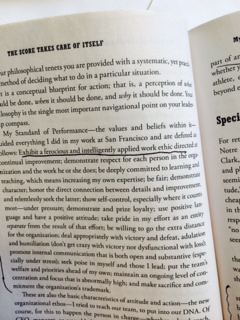
C.   “The Score Takes Care of Itself”- Bill Walsh- We leaned on this book heavily during my first year at Denison.  I felt an energy rush when I learned about his “Standard of Performance.”

This paragraph was a big part of what we tried to do when we took over the Denison Program.

This paragraph was a big part of what we tried to do when we took over the Denison Program.

D.   “The Effective Executive”- Peter Drucker- I get excited just thinking about Drucker’s information.  His statement that effective executives: “Run productive meetings” and  “focus on opportunities rather than problems” changed the way I looked at things.

E.   “Awaken The Giant Within”- Anthony Robbins- If you are not reading and listening to Anthony Robbins you are missing a big opportunity.  Nothing more needs said.

Right now many of you are thinking, “I don’t like to read.” Or, worse yet, “I like to read but I don’t have enough time.”  Reading helps bridge the gab between mediocrity and excellence; therefore, I have learned to love to read and carved out the necessary time to make it happen.  The same people that proclaim they do not have enough time will: watch between 6-10 hours of football this weekend, watch three runs of SportsCenter, watch reruns of Seinfeld and Friends, or play video games every night.  If you decide not to read it’s your choice; it is not because of constraints on your time. 

That’s right, Coaches- I just provided you three articles and five books and not one involved baseball.  And yes, I believe that reading about leadership will do more for your career than “mastering the mental game,” differentiating between a rotational or linear swing teach, or whether you should field the back hand off the front foot or back foot.  While the intricacies of the sport are great to debate, the importance of leadership is  non-negotiable.  Behind every great organization is a strong leader.  What are you willing to invest to become a great leader for your organization???

Please be on the lookout on Sunday for Part Two of Studying Leaders: Learning From Observing and Listening.

Happy Thanksgiving!!

Mike Deegan

P.S. Please share what books or articles have made an impact on you.

Coach’s guilt is a real thing.  Long hours and extended time away from your family is a reality.  If you make the choice to coach you are going to miss weddings, family birthdays, and other events that are important.  Frequently, our profession loses outstanding coaches because of the inability to balance work and family.  I’m here to tell you that if you are striving for a work life balance you will never excel in the coaching profession.

Leaving a game: Joey (4), Elle, (2), Rowan (6 days).

Leaving a game: Joey (4), Elle, (2), Rowan (6 days).

What you must strive for is a work-life integration.  Our profession does not allow for a “normal” lifestyle.  However, that doesn’t mean you cannot thrive as a husband, father, and coach.  My family is fully invested in our baseball program.  I debrief my wife, Lowrie, every day on the team.  She knows the players, we host groups for dinner, and she and the kids attend nearly every game.  We see the players as an extension of our family.

Lowrie and the kids at a road game this fall

Lowrie and the kids at a road game this fall

Sure, most people think we are crazy; however, we believe we have created a great lifestyle. Oh, there are challenges; it’s not easy, but we wouldn’t change it for the world.  We work seven days a week and rarely take a day off.  But, how many people do you know who truly love what they do?

The work-life balance died with cell-phones, emails, and weekly recruiting events.  You will continually feel conflicted if you try to balance your family and work.  I know so many coaches that feel they are underachieving as a coach and failing in their most important jobs as a father and husband.  It doesn’t have to be this way.  Below are four suggestions to create a work-life integration.

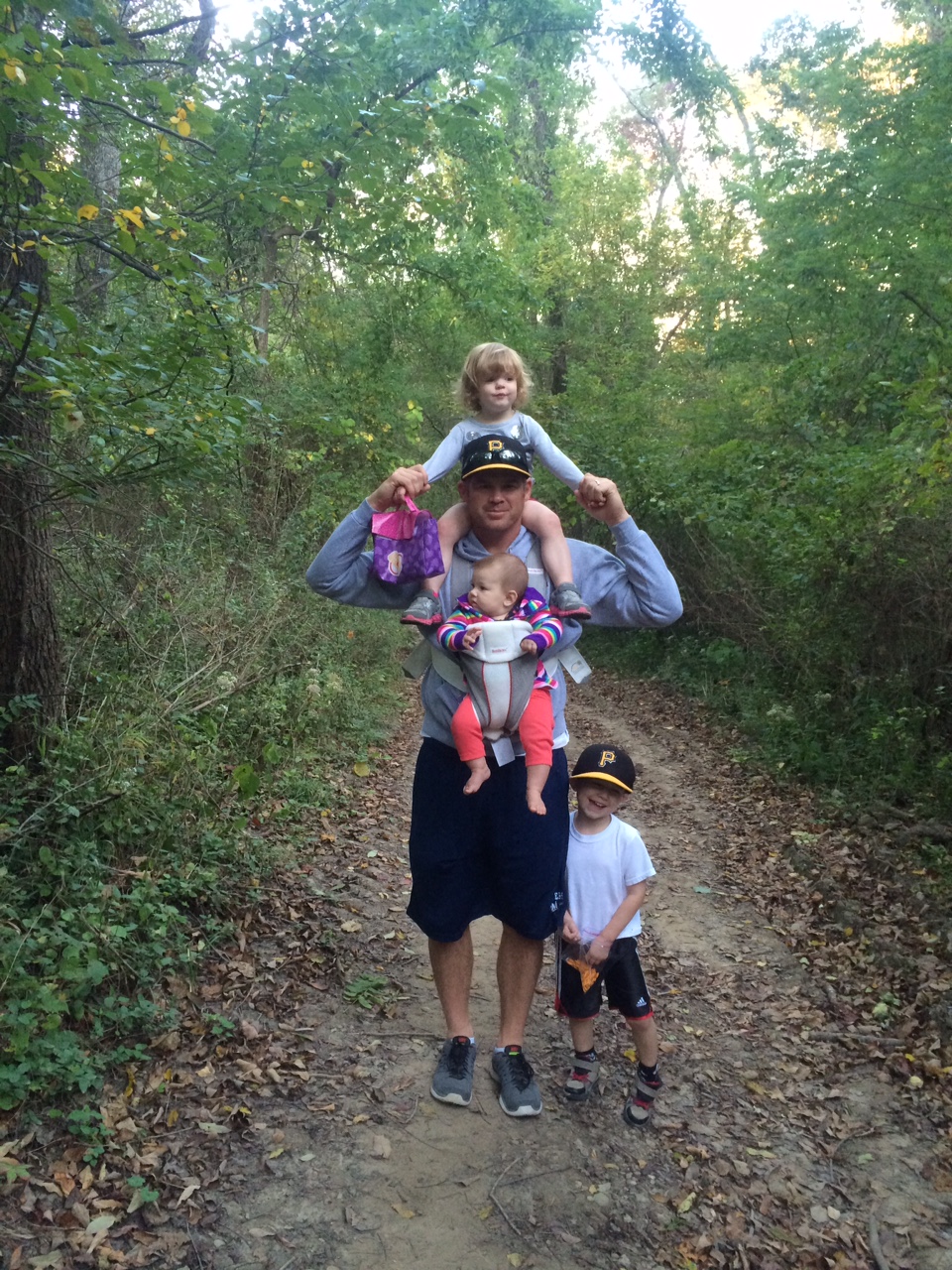
Hiking in the nature reserve behind the baseball complex

Hiking in the nature reserve behind the baseball complex

1.  Live within 10 miles of your work.  Living close to campus allows me to drop my kids off every morning at school or the baby sitter and pick them up most days.  Oftentimes, I will drive home from work, have dinner, help out with baths, and then return to the office for work.

2.  Find a way to steal hours.  I typically try to rise early (6am at the latest) before the kids get moving (my best work sometimes gets done in the middle of the night).  This allows me to answer emails and plan for the day.

3.  “Be where your feet are.”  If you are with the family be with them; if you are at work be at work.  This is definitely the most challenging piece to the work-life integration model.  There comes a time when you need to put the phone down and just be with the family.  In addition, a distracted coach is an ineffective coach.  If you are thinking about things at home while at work your presence will be compromised.

4. Get your family involved in the program.  This is the most critical piece to the puzzle.  If your family is not 100% invested in your program you are going to struggle.  Have your team over for dinner, give the kids team t-shirts, and make sure everyone in the department knows your wife and children.

Coaching is the greatest profession in the world.  It allows your family to be intimately close to your passion.  Coaches who recognize the importance are the ones who are motivated and most importantly happy.

Of course, marrying a rock star is important. There's a special place in heaven for a coaches wife.

Of course, marrying a rock star is important. There’s a special place in heaven for a coach’s wife.

Be outstanding,

Mike Deegan